Understanding the Difference Between Airfield, Aerodrome, and Airport
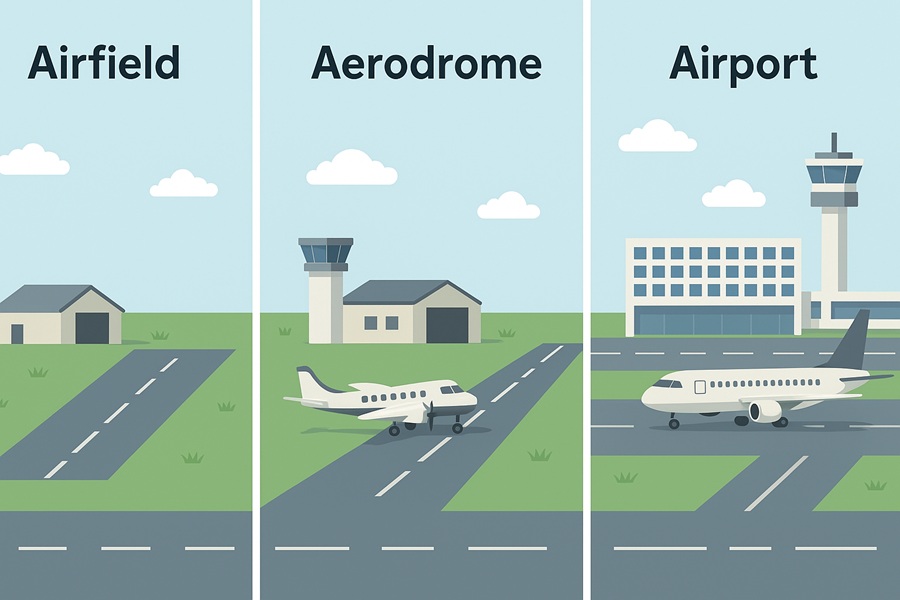
In aviation, clarity in terminology is critical. Terms like airfield, aerodrome, and airport are sometimes used interchangeably, but each has a specific meaning depending on context, infrastructure, and regulatory standards. Whether you’re involved in aviation professionally or just curious about how aviation facilities are classified, understanding these differences can provide valuable insight into how the global airspace system functions.
What Is an Airfield?
An airfield refers to any area where aircraft can take off and land. It is generally the most informal of the three terms. Airfields can be as simple as a flat, grassy surface or as developed as a paved runway with limited support infrastructure. They may lack control towers, passenger terminals, or regular maintenance facilities.
Airfields are commonly used by private pilots, flying clubs, military forces, and agricultural operators. While some are equipped with lighting and basic navigation aids, many operate under visual flight rules (VFR) and are not designed to handle commercial passenger traffic.
What Is an Aerodrome?
An aerodrome is a more formal designation for any location where aircraft operations—such as takeoffs, landings, and taxiing—take place. The term encompasses everything from basic landing strips to large-scale airports. What defines an aerodrome is not its level of service, but its functional role in aviation.
Aerodromes can be civilian or military and may vary widely in terms of size and infrastructure. Some may have just a single runway, while others offer multiple runways, hangars, air traffic control services, and maintenance facilities. The term is widely used in international aviation regulation, particularly in countries aligned with the standards of the International Civil Aviation Organization (ICAO). In many regions, “aerodrome” is the preferred legal or technical term, even when the facility functions as a full-fledged airport.
What Is an Airport?
An airport is a type of aerodrome that meets specific regulatory and operational criteria, typically with a focus on public or commercial air transport. Airports are usually licensed by a national aviation authority and must meet strict requirements related to safety, infrastructure, and passenger services.
Unlike smaller airfields or general-purpose aerodromes, airports offer comprehensive facilities, such as:
- Runways and taxiways designed for commercial aircraft
- Passenger terminals with check-in, baggage handling, and waiting areas
- Security screening and customs (for international airports)
- Air traffic control towers
- Fueling stations and maintenance services
Airports are designed to handle higher volumes of traffic, both passenger and cargo, and are built to support scheduled airline operations. They serve as vital transportation hubs within domestic and international networks.
Key Differences at a Glance
| Term | Primary Use | Infrastructure Level | Regulatory Status | Common Context |
|---|---|---|---|---|
| Airfield | General aviation, military, private use | Minimal to moderate | Often unregulated or lightly regulated | Informal, local operations |
| Aerodrome | Any aircraft operation site | Varies widely | May be regulated under national or ICAO guidelines | Technical/legal aviation term |
| Airport | Commercial air travel, public transport | Extensive infrastructure | Fully regulated | Public transportation hubs |
Practical Examples
- A small private strip on farmland with a grass runway is an airfield and may also be called an aerodrome in regulatory documents.
- A regional facility with paved runways, hangars, and limited services for general aviation is an aerodrome, but not necessarily an airport.
- A facility like Singapore Changi or London Heathrow is both an aerodrome and an airport, with full-scale operations and international recognition.
Conclusion
Understanding the distinctions between airfield, aerodrome, and airport helps clarify how aviation infrastructure is organized and regulated across the globe. While all three refer to locations where aircraft can operate, they differ significantly in terms of usage, complexity, and oversight. Whether you’re dealing with flight planning, aviation policy, or simply expanding your knowledge, using the correct terminology ensures clearer communication in a field where precision is paramount.